Why a Tarmac Driveway With a Cobblelock Border Works
A tarmac driveway with a cobblelock border pairs a smooth, hard-wearing tarmacadam surface with a frame of block paving around the edges. The border holds the tarmac in place, gives a clean finished line and adds colour. It is one of the most popular driveway combinations for homes across Dublin, Kildare, Meath and Wicklow.
This article explains how the two materials work together, the border styles you can choose, how we build this type of driveway from the ground up, what affects the price, and when granite setts or gravel edging might suit your home better.
How Tarmac and Cobblelock Work Together
Tarmacadam is laid hot and compacted with a roller, which gives a seamless black surface with no joints for weeds to root in. It handles the daily weight of cars well and is quick to sweep and clean. Its weakness is the edge. Without a firm restraint, the outer line of tarmac can spread, crumble or break away over time, especially where tyres run close to the side.
A cobblelock border solves that problem. The blocks are bedded and haunched in concrete around the perimeter, so they act as a solid kerb that the tarmac is rolled up against. The result is a crisp edge that stays straight, and a surface that is supported on all sides.
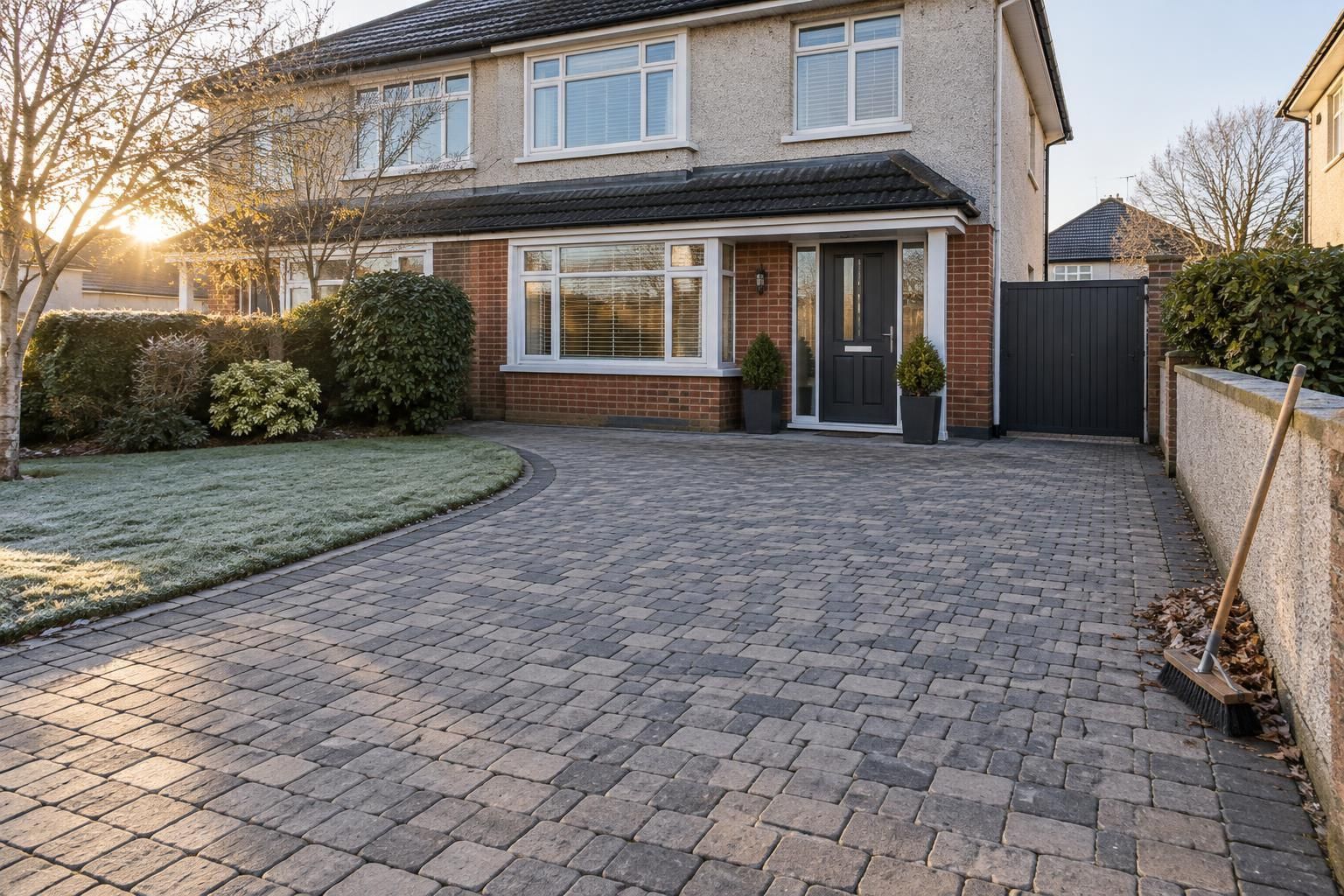
The border also does a design job. A plain black driveway can look flat in front of a red brick or pebbledash house, while a band of grey, charcoal or red blocks picks up colours from the walls, sills and roof. It is a simple way to make a practical surface look finished. You can see more about the base material on our tarmac paving page.
Cobblelock Border Styles and Colours
There is more choice in the border than most people expect. The size of the band, the number of rows and the colour all change how the finished driveway looks. During our survey and consultation we talk through these options with you and look at how they suit the front of your property.
Single or double row borders
A single row of blocks laid end to end gives a slim, tidy outline and suits smaller front gardens. A double or triple row creates a wider frame that stands out more and works well on larger driveways or where the house sits further back from the road.
Contrasting or matching colours
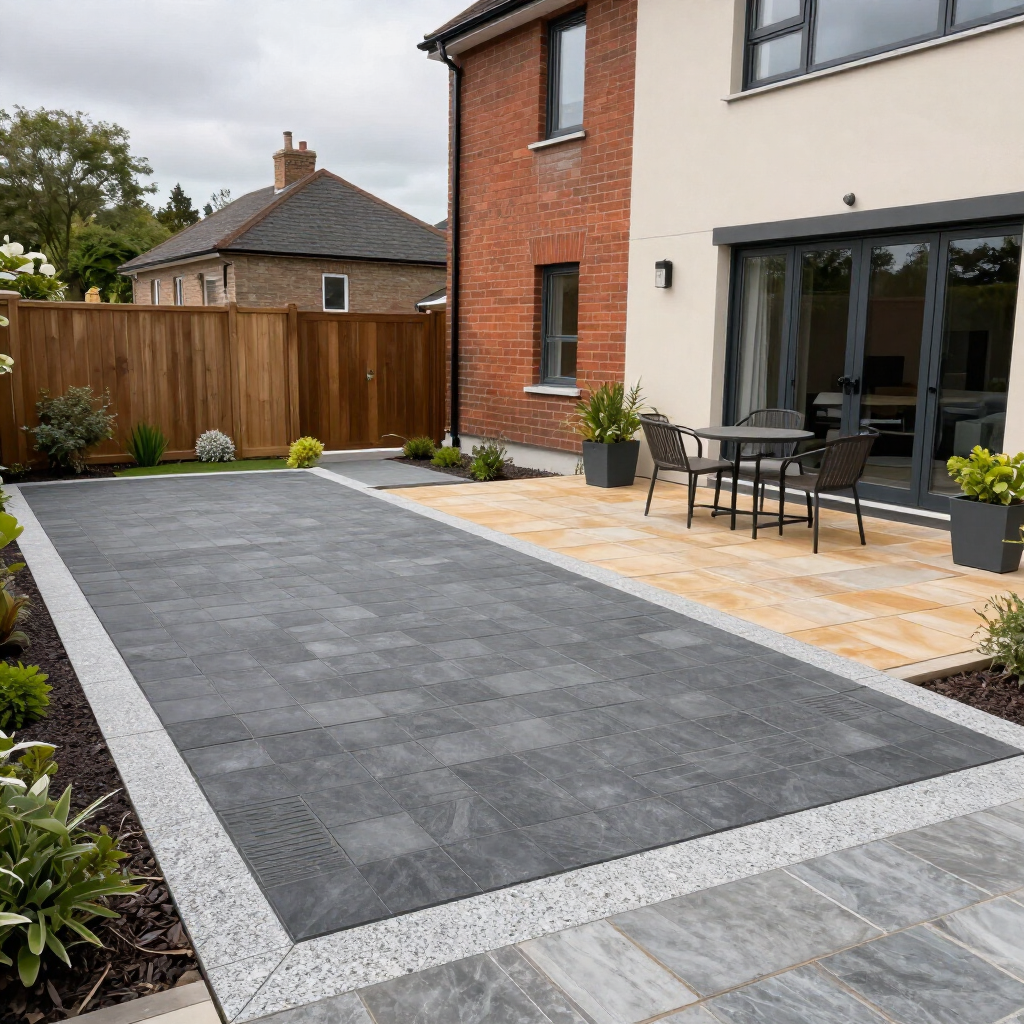
Charcoal blocks give a subtle, modern look against black tarmac. Red or brindle blocks make a stronger contrast and suit red brick homes. Some clients like a two-tone band, with a darker outer row and a lighter inner row.
Features beyond the edge
- Cobblelock strips across the driveway to break up a long run of tarmac
- A block paved apron at the entrance where the driveway meets the gate or footpath
- Matching block paved paths leading to the front door
- Edging around flower beds or lawn areas so the whole garden ties together
Our cobblelock paving page shows the patterns and colours we work with, including herringbone layouts.
How We Build a Tarmac and Cobblelock Driveway
The quality of a driveway depends on what sits underneath it. Most problems people see with older driveways, such as dips, cracks and loose edges, come from a weak base or poor drainage rather than the surface itself. This is the order we follow on a typical job.
- Survey and design. We visit the property, measure the area, check levels and falls, and agree the layout, border style and colours with you.
- Remove the old surface. We break out and take away the existing driveway, concrete, lawn or gravel, along with any debris.
- Excavate and prepare. The ground is dug out to the right depth so the new build-up sits at the correct level against the house and footpath.
- Lay the sub-base. A compacted stone sub-base is laid and levelled with accurate tools. This is the layer that carries the weight of vehicles.
- Set the cobblelock border. The border blocks are laid on a concrete bed and haunched at the back, so they form a firm restraint around the edge.
- Lay the tarmacadam. Hot tarmac is spread inside the border and rolled to compact it, with falls set so rainwater runs off rather than pooling.
- Finish and clean up. We check the edges and levels, tidy the site and walk you through the finished driveway.
Drainage needs particular attention. Tarmac is not permeable, so the surface has to fall towards a drain, channel or soakaway, or towards planted areas that can take the water. Rain should never be directed towards the house or out onto the public footpath. We plan this at the survey stage so it is built into the levels from the start.
What Affects the Cost of a Tarmac Driveway With a Cobblelock Border
Every driveway is different, which is why we price each job after a site survey rather than giving a figure in advance. The main factors that affect the cost are:
- Size and shape. A larger area needs more tarmac and sub-base, and curves or awkward corners take longer to edge.
- Length of the border. The more linear metres of cobblelock, and the more rows, the more blocks and labour are needed.
- What has to come out. Breaking out an old concrete driveway takes more work than lifting a lawn.
- Ground conditions and levels. Soft ground, steep slopes or a need to raise or lower levels can add excavation and sub-base work.
- Drainage. Adding channel drains or a soakaway adds to the cost but protects the driveway and the house.
- Extra features. Paths, steps, gates, entrances and planting areas all change the scope.
Combining tarmac with a block border is often a good balance. The large central area uses tarmacadam, while the cobblelock is kept to the edges where it adds the most strength and visual interest.
Granite Setts and Gravel Edging as Alternatives
Cobblelock is not the only way to frame a tarmac driveway. Depending on the age and style of your home, another edging may suit it better.
Granite setts
Granite setts give a natural stone border with a traditional look that suits period homes and older terraces in Dublin. They are very durable and work well as a frame for tarmac, or as a band at the entrance. We lay granite slabs and cobbles in different shapes and sizes, so the border can be matched to other stonework at the front of the house.
Gravel strips and edging
Some clients like a tarmac driveway with a gravel strip along one side or around planting, which softens the look and lets some rainwater soak into the ground. Gravel always needs a firm edge to keep the stone in place, so a row of cobblelock or setts is still useful between the gravel and the tarmac.
Footpath Access and Permissions
If your new driveway needs a new or wider entrance from the road, check the rules before work starts. Lowering or widening the kerb and footpath outside your property is a matter for your local council, not your contractor. In the Dublin City Council area, for example, you need permission from the council to modify a footpath for vehicular access, and a new or widened dishing generally needs planning permission first. Other councils in Dublin, Kildare, Meath and Wicklow have their own procedures, so contact yours if the entrance is changing.
A Finished Driveway Built to Last
A tarmac driveway with a cobblelock border gives you a smooth, practical surface with strong, tidy edges and a choice of colours to suit your home. With more than 15 years of experience in paving and landscaping, we involve you in the design, prepare the ground properly and guarantee our work for 15 years. We build these driveways for homes across Dublin, Kildare, Meath and Wicklow, and you can see our wider range on the driveways in Dublin page.
To arrange a survey and consultation for your new driveway, contact Paving Design Ltd. Call us on 01 539 2789 or 087 351 0001, or email info@pavingdesignltd.ie.
Tarmac Driveway With a Cobblelock Border for Dublin Homes
November 3, 2026
Share
Why a Tarmac Driveway With a Cobblelock Border Works
A tarmac driveway with a cobblelock border pairs a smooth, hard-wearing tarmacadam surface with a frame of block paving around the edges. The border holds the tarmac in place, gives a clean finished line and adds colour. It is one of the most popular driveway combinations for homes across Dublin, Kildare, Meath and Wicklow.
This article explains how the two materials work together, the border styles you can choose, how we build this type of driveway from the ground up, what affects the price, and when granite setts or gravel edging might suit your home better.
How Tarmac and Cobblelock Work Together
Tarmacadam is laid hot and compacted with a roller, which gives a seamless black surface with no joints for weeds to root in. It handles the daily weight of cars well and is quick to sweep and clean. Its weakness is the edge. Without a firm restraint, the outer line of tarmac can spread, crumble or break away over time, especially where tyres run close to the side.
A cobblelock border solves that problem. The blocks are bedded and haunched in concrete around the perimeter, so they act as a solid kerb that the tarmac is rolled up against. The result is a crisp edge that stays straight, and a surface that is supported on all sides.
The border also does a design job. A plain black driveway can look flat in front of a red brick or pebbledash house, while a band of grey, charcoal or red blocks picks up colours from the walls, sills and roof. It is a simple way to make a practical surface look finished. You can see more about the base material on our tarmac paving page.
Cobblelock Border Styles and Colours
There is more choice in the border than most people expect. The size of the band, the number of rows and the colour all change how the finished driveway looks. During our survey and consultation we talk through these options with you and look at how they suit the front of your property.
Single or double row borders
A single row of blocks laid end to end gives a slim, tidy outline and suits smaller front gardens. A double or triple row creates a wider frame that stands out more and works well on larger driveways or where the house sits further back from the road.
Contrasting or matching colours
Charcoal blocks give a subtle, modern look against black tarmac. Red or brindle blocks make a stronger contrast and suit red brick homes. Some clients like a two-tone band, with a darker outer row and a lighter inner row.
Features beyond the edge
- Cobblelock strips across the driveway to break up a long run of tarmac
- A block paved apron at the entrance where the driveway meets the gate or footpath
- Matching block paved paths leading to the front door
- Edging around flower beds or lawn areas so the whole garden ties together
Our cobblelock paving page shows the patterns and colours we work with, including herringbone layouts.
How We Build a Tarmac and Cobblelock Driveway
The quality of a driveway depends on what sits underneath it. Most problems people see with older driveways, such as dips, cracks and loose edges, come from a weak base or poor drainage rather than the surface itself. This is the order we follow on a typical job.
- Survey and design. We visit the property, measure the area, check levels and falls, and agree the layout, border style and colours with you.
- Remove the old surface. We break out and take away the existing driveway, concrete, lawn or gravel, along with any debris.
- Excavate and prepare. The ground is dug out to the right depth so the new build-up sits at the correct level against the house and footpath.
- Lay the sub-base. A compacted stone sub-base is laid and levelled with accurate tools. This is the layer that carries the weight of vehicles.
- Set the cobblelock border. The border blocks are laid on a concrete bed and haunched at the back, so they form a firm restraint around the edge.
- Lay the tarmacadam. Hot tarmac is spread inside the border and rolled to compact it, with falls set so rainwater runs off rather than pooling.
- Finish and clean up. We check the edges and levels, tidy the site and walk you through the finished driveway.
Drainage needs particular attention. Tarmac is not permeable, so the surface has to fall towards a drain, channel or soakaway, or towards planted areas that can take the water. Rain should never be directed towards the house or out onto the public footpath. We plan this at the survey stage so it is built into the levels from the start.
What Affects the Cost of a Tarmac Driveway With a Cobblelock Border
Every driveway is different, which is why we price each job after a site survey rather than giving a figure in advance. The main factors that affect the cost are:
- Size and shape. A larger area needs more tarmac and sub-base, and curves or awkward corners take longer to edge.
- Length of the border. The more linear metres of cobblelock, and the more rows, the more blocks and labour are needed.
- What has to come out. Breaking out an old concrete driveway takes more work than lifting a lawn.
- Ground conditions and levels. Soft ground, steep slopes or a need to raise or lower levels can add excavation and sub-base work.
- Drainage. Adding channel drains or a soakaway adds to the cost but protects the driveway and the house.
- Extra features. Paths, steps, gates, entrances and planting areas all change the scope.
Combining tarmac with a block border is often a good balance. The large central area uses tarmacadam, while the cobblelock is kept to the edges where it adds the most strength and visual interest.
Granite Setts and Gravel Edging as Alternatives
Cobblelock is not the only way to frame a tarmac driveway. Depending on the age and style of your home, another edging may suit it better.
Granite setts
Granite setts give a natural stone border with a traditional look that suits period homes and older terraces in Dublin. They are very durable and work well as a frame for tarmac, or as a band at the entrance. We lay granite slabs and cobbles in different shapes and sizes, so the border can be matched to other stonework at the front of the house.
Gravel strips and edging
Some clients like a tarmac driveway with a gravel strip along one side or around planting, which softens the look and lets some rainwater soak into the ground. Gravel always needs a firm edge to keep the stone in place, so a row of cobblelock or setts is still useful between the gravel and the tarmac.
Footpath Access and Permissions
If your new driveway needs a new or wider entrance from the road, check the rules before work starts. Lowering or widening the kerb and footpath outside your property is a matter for your local council, not your contractor. In the Dublin City Council area, for example, you need permission from the council to modify a footpath for vehicular access, and a new or widened dishing generally needs planning permission first. Other councils in Dublin, Kildare, Meath and Wicklow have their own procedures, so contact yours if the entrance is changing.
A Finished Driveway Built to Last
A tarmac driveway with a cobblelock border gives you a smooth, practical surface with strong, tidy edges and a choice of colours to suit your home. With more than 15 years of experience in paving and landscaping, we involve you in the design, prepare the ground properly and guarantee our work for 15 years. We build these driveways for homes across Dublin, Kildare, Meath and Wicklow, and you can see our wider range on the driveways in Dublin page.
To arrange a survey and consultation for your new driveway, contact Paving Design Ltd. Call us on 01 539 2789 or 087 351 0001, or email info@pavingdesignltd.ie.
Recent Posts