Porcelain Patio and Artificial Grass Ideas for Irish Gardens
A porcelain patio and artificial grass work well together in Dublin gardens because both stay usable after rain, need little upkeep and give a clean, level finish. The key is planning the layout, levels and drainage as one job, so the paving falls away from the house and the lawn drains freely through a properly built sub-base.
Below we set out layout ideas, how each surface is built, how to deal with Irish rain, where roll-on turf might suit you better, and what to ask before work starts. It draws on more than 15 years of building gardens across Dublin, Kildare, Meath and Wicklow.
Why Porcelain Paving Suits Artificial Grass
Outdoor porcelain is a dense, fired tile with very low water absorption, so it resists staining, moss and the green algae that builds up on many paving slabs over a damp winter. It holds its colour well and is usually cleaned with a brush and water. Artificial grass has the same appeal on the lawn side: no mowing, no muddy patches and no bare spots under the children's goalposts.
Together they create a garden that looks tidy all year with very little weekend work. The straight, crisp edges of outdoor porcelain paving also give artificial grass a firm line to butt up against, which helps the lawn look neat and keeps its edges from lifting. For many families in Dublin housing estates, where back gardens are compact and often shaded by fences, this combination makes the space feel larger and more usable.
Choosing colours that work together
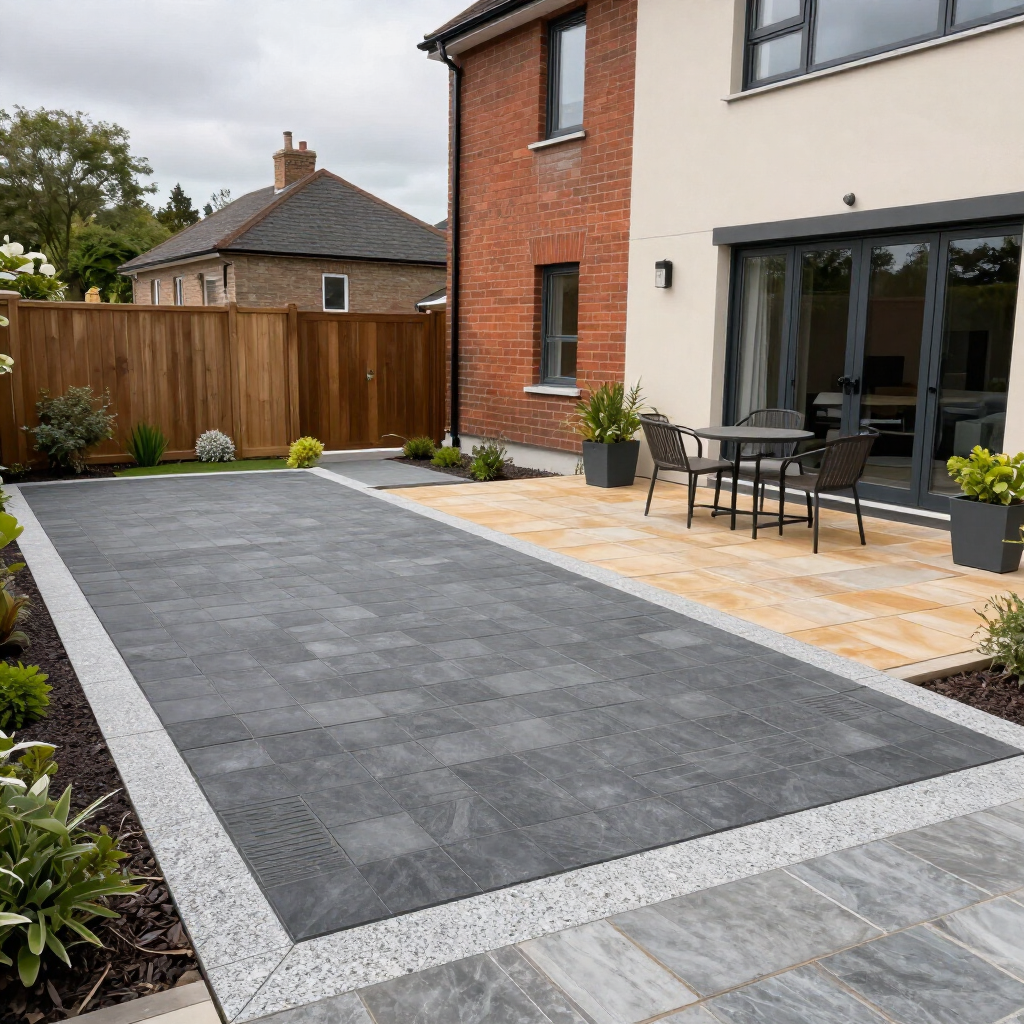
Light and mid-grey porcelain is the most popular choice beside a green lawn because it reads as clean and modern without competing with the grass. Warmer buff and sandstone-effect porcelain softens the look and sits well beside red brick walls. Charcoal porcelain gives strong contrast but shows dust and dried water marks more easily. When choosing, look at samples outside in natural daylight and wet them, since the colour of porcelain changes noticeably in rain.
Garden Layout Ideas for Porcelain and Artificial Grass
The right layout depends on how you use the garden, where the sun falls and how the ground slopes. These are the layouts we are asked for most often.
- Patio by the house, lawn beyond. The classic layout. A porcelain patio outside the back doors gives a dry route out of the kitchen, with artificial grass filling the rest of the garden.
- Patio at the back of the garden. In many Dublin gardens the evening sun reaches the far end, not the house. A second seating area there, linked by a porcelain path, makes the most of it.
- Stepping-stone path through the lawn. Porcelain slabs set into artificial grass create a walkway to a shed or gate without breaking up the lawn.
- Curved or angled lawn edge. Porcelain can be cut to follow a curve, which softens a narrow rectangular garden.
- Raised beds and borders. Planted borders around the edge add colour and give real plants a home beside the artificial lawn.
Whatever the layout, think about where furniture, a barbecue, bins and children's play equipment will sit. Heavy, hot or sharp items belong on the porcelain, not on the artificial grass.
How a Porcelain Patio Is Built to Last
Porcelain looks simple once laid, but it is less forgiving than concrete slabs, so preparation matters. On every job we start by removing the old surface and any debris, then digging out to the correct depth and checking levels with accurate tools.
- Excavation and sub-base. The area is dug out and a compacted stone sub-base is laid to give a firm, stable platform.
- Setting the falls. The patio is built with a gentle fall away from the house so rainwater runs off and never sits against walls or doors.
- Full mortar bed. Porcelain is laid on a full bed of mortar, with a bonding primer on the back of each slab, because its smooth underside does not grip mortar the way natural stone does.
- Jointing. Joints are filled with a suitable jointing compound to finish the surface and limit weed growth.
Skipping the primer, laying on spots of mortar or getting the falls wrong are the most common reasons porcelain slabs rock, crack or hold puddles. Alongside porcelain, we also build patios in natural stone, clay brick and resin bound gravel.
Artificial Grass Installation and Drainage in Dublin
Dublin gets a lot of rain over the winter, and heavy clay soil is common in parts of the county, so drainage is the single most important part of fitting artificial grass. A good artificial lawn lets water pass through its backing and down into the ground beneath, which only works if the base below is built for it.
A typical installation involves removing the existing grass and topsoil, laying and compacting a free-draining stone sub-base, adding a fine laying course levelled to a smooth finish, and fitting a weed membrane. The grass is then rolled out, joined, trimmed and fixed along firm edging. Where the lawn meets your porcelain patio, the edge is set so the grass sits flush with or just below the paving, giving a clean line and a safe step.
Our artificial grass supply and fitting service covers gardens of all sizes. If your garden has standing water after rain today, tell us at the survey stage, as it may need extra drainage work before any surface goes down.
Levels between patio and lawn
Planning the patio and lawn together means the falls can be designed as one system. The patio sheds water towards the garden or a drain, and the lawn base is built to take it. Getting this right avoids a common problem where a new patio sends all its runoff onto one corner of the lawn.
When Roll-On Turf Is the Better Choice
Artificial grass is not right for every garden. Some people prefer the feel and smell of a real lawn, want to support wildlife, or have a large garden where a natural lawn makes more sense. In those cases, roll-on turf gives you an instant green lawn without waiting for seed to establish.
Real turf needs mowing, feeding and watering in dry spells, and it can wear thin in heavy-use or shaded areas. A sensible middle ground in some gardens is a porcelain patio with artificial grass in the shaded, high-traffic part near the house and natural turf further back where it gets more light.
What to Ask Before You Start
A good garden project starts with a proper survey and an honest conversation. These are the questions worth asking any contractor.
- How will the patio and lawn drain, and where will the water go?
- How deep will the excavation and sub-base be, and will the old surface be taken away?
- Will porcelain be laid on a full mortar bed with a bonding primer?
- What edging will hold the artificial grass in place?
- Can I see porcelain and grass samples before choosing?
- What guarantee comes with the work?
At Paving Design Ltd every project begins with a survey and consultation, and we involve our clients in the design so the finished garden suits the property, the way it is used and the budget. We guarantee our work for 15 years.
Planning Your New Garden
A porcelain patio and artificial grass can turn a muddy or tired back garden into a space you use all year, as long as the layout, levels and drainage are planned as one project. We design and build these gardens for homes across Dublin, Kildare, Meath and Wicklow, from compact terraced gardens to larger family plots.
To arrange a survey and consultation, contact Paving Design Ltd. Call us on 01 539 2789 or 087 351 0001, or email info@pavingdesignltd.ie.
Porcelain Patio and Artificial Grass Garden Ideas for Dublin
November 3, 2026
Share
Porcelain Patio and Artificial Grass Ideas for Irish Gardens
A porcelain patio and artificial grass work well together in Dublin gardens because both stay usable after rain, need little upkeep and give a clean, level finish. The key is planning the layout, levels and drainage as one job, so the paving falls away from the house and the lawn drains freely through a properly built sub-base.
Below we set out layout ideas, how each surface is built, how to deal with Irish rain, where roll-on turf might suit you better, and what to ask before work starts. It draws on more than 15 years of building gardens across Dublin, Kildare, Meath and Wicklow.
Why Porcelain Paving Suits Artificial Grass
Outdoor porcelain is a dense, fired tile with very low water absorption, so it resists staining, moss and the green algae that builds up on many paving slabs over a damp winter. It holds its colour well and is usually cleaned with a brush and water. Artificial grass has the same appeal on the lawn side: no mowing, no muddy patches and no bare spots under the children's goalposts.
Together they create a garden that looks tidy all year with very little weekend work. The straight, crisp edges of outdoor porcelain paving also give artificial grass a firm line to butt up against, which helps the lawn look neat and keeps its edges from lifting. For many families in Dublin housing estates, where back gardens are compact and often shaded by fences, this combination makes the space feel larger and more usable.
Choosing colours that work together
Light and mid-grey porcelain is the most popular choice beside a green lawn because it reads as clean and modern without competing with the grass. Warmer buff and sandstone-effect porcelain softens the look and sits well beside red brick walls. Charcoal porcelain gives strong contrast but shows dust and dried water marks more easily. When choosing, look at samples outside in natural daylight and wet them, since the colour of porcelain changes noticeably in rain.
Garden Layout Ideas for Porcelain and Artificial Grass
The right layout depends on how you use the garden, where the sun falls and how the ground slopes. These are the layouts we are asked for most often.
- Patio by the house, lawn beyond. The classic layout. A porcelain patio outside the back doors gives a dry route out of the kitchen, with artificial grass filling the rest of the garden.
- Patio at the back of the garden. In many Dublin gardens the evening sun reaches the far end, not the house. A second seating area there, linked by a porcelain path, makes the most of it.
- Stepping-stone path through the lawn. Porcelain slabs set into artificial grass create a walkway to a shed or gate without breaking up the lawn.
- Curved or angled lawn edge. Porcelain can be cut to follow a curve, which softens a narrow rectangular garden.
- Raised beds and borders. Planted borders around the edge add colour and give real plants a home beside the artificial lawn.
Whatever the layout, think about where furniture, a barbecue, bins and children's play equipment will sit. Heavy, hot or sharp items belong on the porcelain, not on the artificial grass.
How a Porcelain Patio Is Built to Last
Porcelain looks simple once laid, but it is less forgiving than concrete slabs, so preparation matters. On every job we start by removing the old surface and any debris, then digging out to the correct depth and checking levels with accurate tools.
- Excavation and sub-base. The area is dug out and a compacted stone sub-base is laid to give a firm, stable platform.
- Setting the falls. The patio is built with a gentle fall away from the house so rainwater runs off and never sits against walls or doors.
- Full mortar bed. Porcelain is laid on a full bed of mortar, with a bonding primer on the back of each slab, because its smooth underside does not grip mortar the way natural stone does.
- Jointing. Joints are filled with a suitable jointing compound to finish the surface and limit weed growth.
Skipping the primer, laying on spots of mortar or getting the falls wrong are the most common reasons porcelain slabs rock, crack or hold puddles. Alongside porcelain, we also build patios in natural stone, clay brick and resin bound gravel.
Artificial Grass Installation and Drainage in Dublin
Dublin gets a lot of rain over the winter, and heavy clay soil is common in parts of the county, so drainage is the single most important part of fitting artificial grass. A good artificial lawn lets water pass through its backing and down into the ground beneath, which only works if the base below is built for it.
A typical installation involves removing the existing grass and topsoil, laying and compacting a free-draining stone sub-base, adding a fine laying course levelled to a smooth finish, and fitting a weed membrane. The grass is then rolled out, joined, trimmed and fixed along firm edging. Where the lawn meets your porcelain patio, the edge is set so the grass sits flush with or just below the paving, giving a clean line and a safe step.
Our artificial grass supply and fitting service covers gardens of all sizes. If your garden has standing water after rain today, tell us at the survey stage, as it may need extra drainage work before any surface goes down.
Levels between patio and lawn
Planning the patio and lawn together means the falls can be designed as one system. The patio sheds water towards the garden or a drain, and the lawn base is built to take it. Getting this right avoids a common problem where a new patio sends all its runoff onto one corner of the lawn.
When Roll-On Turf Is the Better Choice
Artificial grass is not right for every garden. Some people prefer the feel and smell of a real lawn, want to support wildlife, or have a large garden where a natural lawn makes more sense. In those cases, roll-on turf gives you an instant green lawn without waiting for seed to establish.
Real turf needs mowing, feeding and watering in dry spells, and it can wear thin in heavy-use or shaded areas. A sensible middle ground in some gardens is a porcelain patio with artificial grass in the shaded, high-traffic part near the house and natural turf further back where it gets more light.
What to Ask Before You Start
A good garden project starts with a proper survey and an honest conversation. These are the questions worth asking any contractor.
- How will the patio and lawn drain, and where will the water go?
- How deep will the excavation and sub-base be, and will the old surface be taken away?
- Will porcelain be laid on a full mortar bed with a bonding primer?
- What edging will hold the artificial grass in place?
- Can I see porcelain and grass samples before choosing?
- What guarantee comes with the work?
At Paving Design Ltd every project begins with a survey and consultation, and we involve our clients in the design so the finished garden suits the property, the way it is used and the budget. We guarantee our work for 15 years.
Planning Your New Garden
A porcelain patio and artificial grass can turn a muddy or tired back garden into a space you use all year, as long as the layout, levels and drainage are planned as one project. We design and build these gardens for homes across Dublin, Kildare, Meath and Wicklow, from compact terraced gardens to larger family plots.
To arrange a survey and consultation, contact Paving Design Ltd. Call us on 01 539 2789 or 087 351 0001, or email info@pavingdesignltd.ie.
Recent Posts